
Gaps in laminate flooring usually appear because the planks have shrunk, shifted or been pinned in place. Common causes are big swings in temperature and humidity, a missing expansion gap at the walls, heavy fixed units and an uneven base. Not every visible line is a fault: the wall gap and bevelled plank edges are designed features, while a joint that has opened between two planks has a cause to find. The right repair depends on that cause and on the floor’s locking system.
Is It a Gap or a Design Feature?
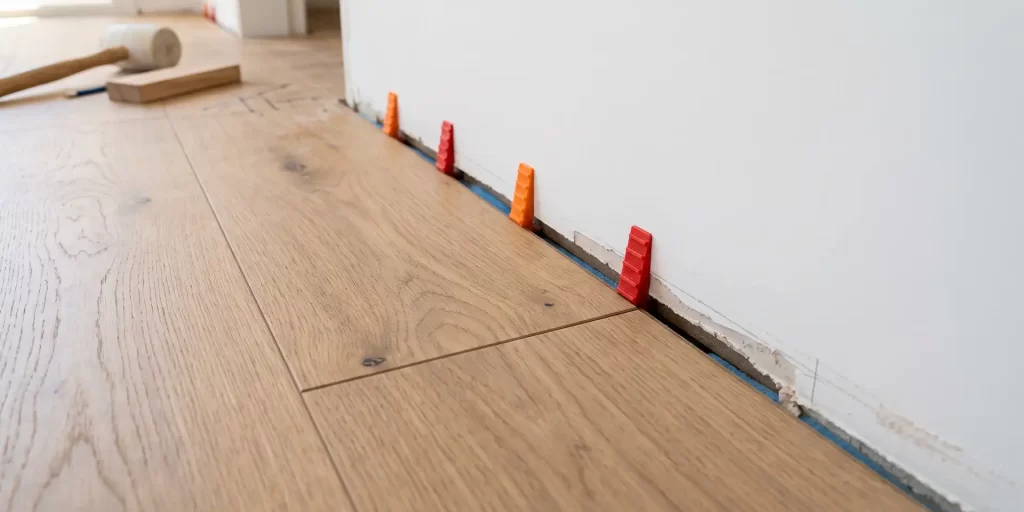
Before treating a gap as a fault, check which kind of line you are looking at:
- The expansion gap at the walls: an intentional space that lets the floor move, which Egger’s guidance puts at 8 to 10 mm and which skirting should hide. If you can see it, the skirting has moved or is too narrow.
- Bevelled edges: shallow grooves designed into some decors to define each plank. They are even and run along every board.
- An opened joint: a gap between two planks where you can see the locking profile or the underlay. This is the real fault.
In this guide, horizontal gaps in laminate flooring run along the long edges of the planks, between rows, and vertical gaps are the short openings at the end joints, where one plank meets the next in the same row.
What Causes Gaps in Laminate Flooring?
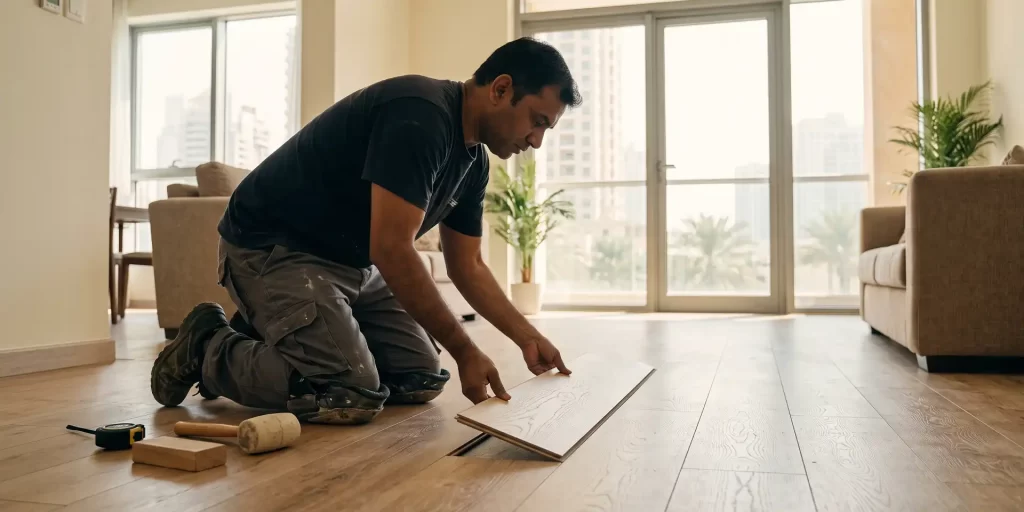
Laminate has a fibreboard core that expands slightly in humid conditions and shrinks in dry ones, so a floating floor must be free to move as one surface. Gaps in laminate flooring form when that movement is restricted or uneven:
- Climate swings: indoor humidity can drop sharply under constant air conditioning and rise when a villa is left closed over summer without cooling. Knowing how heat and humidity in Dubai affect flooring helps explain why joints open as conditions change.
- No room to move: without an expansion gap at walls, door frames and pipes, planks press against fixed points and joints open elsewhere.
- A pinned floor: Egger states that kitchen units and heavy fitted cabinets must not be installed on its floors, and that sealing joints or fixing individual planks can lead to open joints and bulges.
- An uneven subfloor: dips and humps let planks flex underfoot, which gradually works the click joints apart.
- Skipped acclimatisation: planks laid without time to adjust to the room keep moving after they are laid, which is why Egger requires acclimatisation.
- Damaged or dirty joints: grit or chipped edges stop the locking profile from closing fully.
Read the Pattern Before You Repair
Where and how the gaps appear usually points to the cause, so note what you see before anyone touches the floor:
- Fine, even openings at many joints: usually shrinkage in dry conditions. Compare the temperature and relative humidity in the room with the product’s requirements.
- Gaps in one area or one row: look for a pinned point nearby, such as a fitted unit, a screw or sealant, or for a damaged joint.
- Gaps that widen over weeks: the floor may be sliding toward a fixed point, or the base may be uneven.
- Raised or peaked joints elsewhere: the floor is pressing against walls or fixed objects.
Write down the gap width, whether it is growing, which edge opened, which way the planks moved and whether the wall gap on the opposite side has closed. An installer needs exactly this, plus the product name and how the floor was laid. If the floor came from Floorna, its product page lists the size, thickness and classification.
How to Fix Gaps in Laminate Flooring?
Gaps close for good only once the cause is dealt with, because a joint will not stay closed while the floor is still restricted or the room is outside its required conditions. Bring temperature and humidity back within the product’s limits and free any point where the floor is fixed. Detaching fitted units from the floor is work for the installer or kitchen fitter, and any sealant in the expansion gap should be removed in line with the installation instructions.
The repair itself depends on how the floor locks together, so it helps to understand how click system floors join.
How to Fix Horizontal Gaps in Laminate Flooring?
A gap along the long edge means rows have moved apart. Vacuum loose grit out of the joint first, because dirt stops the profile from closing. Do not force the joint from the surface: striking planks with a rubber mallet can break the locking profile if the system is not designed to close that way. Depending on the product, an installer either works the free rows back together or lifts and relays them.
How to Fix Vertical Gaps in Laminate Flooring?
Short gaps at plank ends usually mean a row has slid along its length, often because one end of the floor is pinned. Short ends are often joined differently from long edges, so a method for one does not automatically suit the other. On some systems, an installer can ease a free row back with a tapping block placed against the plank edge; on others, the row must be lifted. Never strike the edge of a plank directly, because this damages the locking profile.
If a gap reopens within days, the cause has not been fixed: the floor may still be pinned, the room may still be outside the required conditions, or the joint may be damaged, in which case the planks need to be lifted and relaid or replaced. Keep spare planks from the installation, because replacements should match the original decor.
Should You Fill the Gaps?
Advice on how to fill gaps in laminate flooring often suggests filler or caulk, but filling does not repair an open joint and can hide a cause that is still active. Egger presents its Decor Mix & Fill paste for light scratches and minor surface damage, not as a joint filler. The wall gap should not be sealed with silicone either: Egger treats it as a movement joint, warns that sealing can lead to open joints and bulges, and names sprayed cork or a PE joint profile as alternatives.
Preventing Gaps from Coming Back
Most gaps are prevented at installation. Egger’s guidance for preventing gaps in laminate flooring sets out clear requirements:
- Acclimatise new planks for at least 48 hours in the room where they will be laid.
- Keep the room at 18 °C or above, with humidity between 40% and 70%, before, during and after installation.
- Leave the expansion gap at every wall, door frame, pipe and fixed object.
- Respect the maximum floating area: 10 by 10 metres for NatureSense and NatureSense Aqua, and 15 by 15 metres for NatureSense Aqua+. Beyond that, a movement profile is needed.
- Fit door bars at doorways, level the subfloor and use a suitable impact sound underlay.
Requirements can differ between product lines, so check the instructions supplied with your specific Egger laminate flooring, or the manufacturer’s instructions for any other product. In a property that stands empty for long periods, keeping the air conditioning at a steady setting, rather than switching it off completely, helps avoid the large swings that open gaps in laminate flooring.
Signs You Need an Installer
If gaps cover large areas, keep returning or appear alongside raised or springy joints, the cause usually lies in the installation or the subfloor, and closing joints without fixing that cause will only hide it for a while. A professional can check the expansion gaps, the base and the underlay, then relay the floor where needed.
Floorna offers professional flooring installation in Dubai, and you can request a free flooring quote before any work begins.
Frequently Asked Questions
1. Is it normal to have gaps in laminate flooring?
A gap between the floor and the wall is normal, because laminate needs an expansion gap that skirting should cover, and bevelled plank edges are part of the design. A joint that has opened between two planks is different: it points to a cause, such as dry or humid conditions, a pinned floor or an uneven base, that should be found before the repair.
2. How to fix laminate flooring that has gaps?
Deal with the cause first, then close the joint in the way the product’s locking system and installation method allow. That can mean working free planks back together, relaying rows or replacing damaged planks.
3. What is a good gap filler for laminate floors?
No filler repairs an open joint between planks; once the cause is fixed, the joint needs closing or the planks need replacing. Laminate repair pastes are made for scratches and minor surface damage, and Egger advises against sealing the wall gap with silicone.