
Choosing the right floor for a Dubai home or workspace comes down to two questions: how well it performs in a hot, humid climate, and how cleanly it can be fitted. Click system floors answer both. These are floating floors whose planks or tiles lock together mechanically, without adhesive spread across the subfloor, which makes them quick to fit and easy to lift or replace later. For residential and commercial projects across the UAE, this flooring has become a default choice for owners who want a premium finish without the mess and downtime of older glue-down methods. At Floorna, it is supplied and installed by a team that understands exactly how these products behave in local conditions.
What are click system floors?
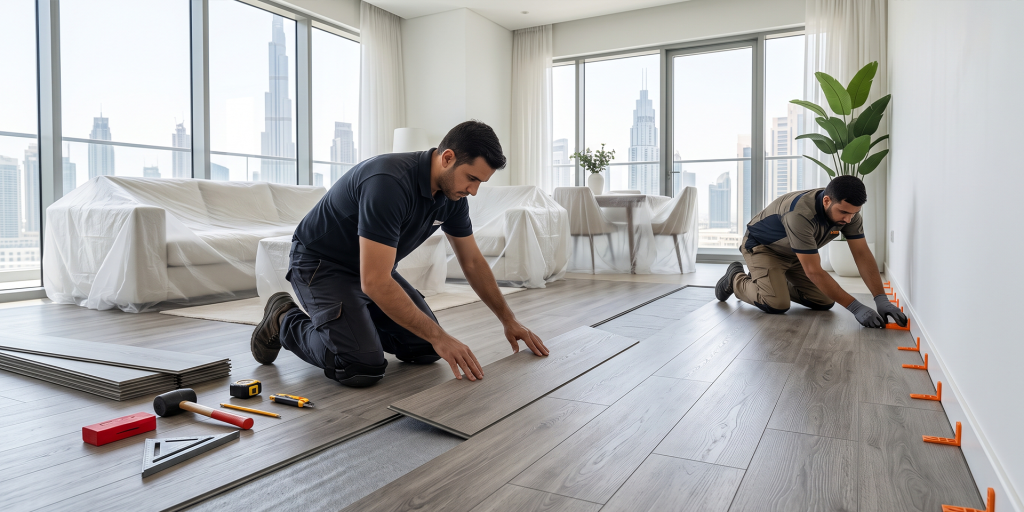
Click system floors are engineered planks or tiles fitted with a machined locking profile along each edge. Instead of gluing the material to the ground, each piece snaps into the one beside it, forming a single connected surface that floats over the subfloor. The result is a floor held together by its own geometry, not adhesive. This category covers most modern luxury vinyl, rigid core, and laminate products, and it is the reason these floors can be laid in a fraction of the time a bonded floor demands. Because nothing is stuck down, the surface can expand and contract slightly with temperature changes, which matters greatly in the UAE.
How does a click system work?
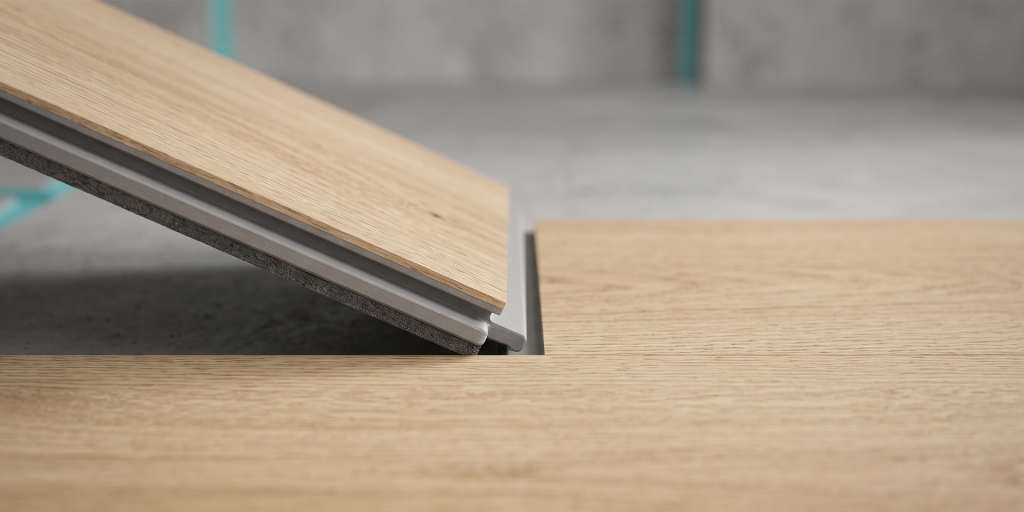
The mechanism is simple but precise. Every plank carries a tongue on one edge and a matching groove on the other. During fitting, the tongue of one plank is angled into the groove of the next and pressed flat, at which point the profile locks firm. Two common formats exist: an angle-and-fold joint and a drop-lock joint that engages under light pressure. Both create a tight seam that resists sideways movement and keeps moisture from working into the joint. Well-made click system floors are milled to tight tolerances, so the seams sit flush and the finished surface feels like one continuous plane underfoot.
Which floor types use a click system?
The click mechanism is not tied to a single material. It appears across several premium categories available at Floorna. Rigid core LVT, such as Bergo Rigid LVT, uses a click-lock profile for glue-free fitting and is valued for its dimensional stability in demanding rooms. Luxury Vinyl Flooring comes in click formats that pair a realistic wood or stone visual with a comfortable, quiet feel underfoot. Laminate ranges apply the same principle, delivering strong scratch and stain resistance at an accessible price. Even parts of the Gerflor vinyl flooring in the UAE collection are offered in click formats alongside bonded options. Whatever the material, click system floors share one core advantage: a mechanical joint that removes adhesive from the equation.
How are click system floors installed in Dubai?
Installation looks effortless when it is done well, but the finish depends entirely on preparation and technique. Here is how a professional click system floors installation is carried out on a typical Dubai project.
Prepare and level the subfloor
Everything starts with the surface underneath. The subfloor is cleaned, checked for moisture, and levelled until it is flat within tolerance, often with a self-levelling compound where the base is uneven. A flat, dry base is non-negotiable, because a floating floor telegraphs every dip and ridge below it. In Dubai’s climate, moisture testing at this stage guards against problems that only surface months later.
Lay the underlay
Next comes the underlay, a thin resilient layer rolled out across the prepared subfloor. It cushions the floor, reduces impact noise between rooms, and in many cases adds a moisture barrier suited to the region’s humidity. Some rigid products arrive with an underlay pre-attached, in which case a separate layer is skipped. Getting this stage right is a quiet but essential part of the job.
Click the planks row by row
Laying begins along the longest straight wall, with a small expansion gap left around the perimeter. Each plank is angled into its neighbour and clicked home, row by row, with joints staggered for strength and a natural look. Cuts are made at walls, doorways, and pipes so the pattern stays clean. Because the planks lock rather than bond, an experienced crew covers a large area in a single day.
Finish edges and skirting
The final stage is trim. The expansion gap is concealed behind skirting or beading, transitions are fitted at doorways, and the whole surface is cleaned down. Done properly, the edges look intentional and the floor reads as one seamless plane, wall to wall.
Benefits of click system floors
The appeal is practical. Click system floors fit faster than bonded floors, which shortens disruption in an occupied home or office. They can be lifted and refitted, so a damaged plank is swapped without tearing up the whole floor. With no wet adhesive, there are no fumes and no long curing time, and the space is usable almost immediately. Most modern ranges are waterproof or highly water resistant, an obvious advantage in a humid city, and many carry antibacterial finishes for a cleaner interior. Add realistic wood and stone visuals, and it is easy to see why this flooring dominates residential and commercial specifications across the UAE.
Click system vs glue-down floors
Both methods have their place, and the right one depends on the space. Glue-down floors are bonded directly to the subfloor, which can suit very high-traffic commercial areas or spaces with specific acoustic needs. The trade-off is a slower, messier fit, a curing period before use, and a harder removal later. A floating floor, by contrast, sits over the subfloor, installs quickly, and lifts cleanly when needed. For most homes, apartments, and offices in Dubai, that speed and flexibility make click system floors the more practical choice. Floorna advises on the right method for each project rather than forcing one approach on every job.
Frequently asked questions
What does click system flooring mean?
It refers to flooring where each plank or tile has a machined locking edge, so pieces snap together into a floating surface instead of being glued down. The floor is held together mechanically and rests over the subfloor.
How do click floors lock together?
Each plank has a tongue and a matching groove. The tongue is angled or pressed into the groove of the adjacent plank, and the milled profile locks the two, forming a tight, stable seam.
Do click system floors need glue?
No, and that is the whole point. They rely on a mechanical joint, so no adhesive is spread across the subfloor, which is what makes them fast to fit and easy to lift later.
Can you install click flooring over tiles?
Often, yes, provided the existing tiles are sound, flat, and clean. Any uneven grout lines are levelled first and an underlay is added, so the new floating floor rests on a smooth base.
Which is better: click or glue-down flooring?
It depends on the room. Click flooring wins on speed, flexibility, and clean fitting for most residential and light commercial spaces, while glue-down can suit specific heavy-duty or acoustic applications. A short site assessment settles it.
Click system floors give Dubai homes and businesses a fast, clean, and durable solution built for the local climate. From rigid core LVT to laminate and vinyl ranges, the mechanical joint keeps fitting quick and the finished floor simple to maintain and repair. For expert product selection and a precise click system floors installation, Floorna delivers the full service across Dubai and the wider UAE.