
Laminate flooring thickness is the depth of the board, usually 6mm to 12mm, and it changes how solid the floor feels and how high it sits at doors. It does not set wear resistance or water resistance. Choose the usage class first, then check thickness, underlay and finished height. This guide explains each decision.
What thickness of laminate flooring do you need?
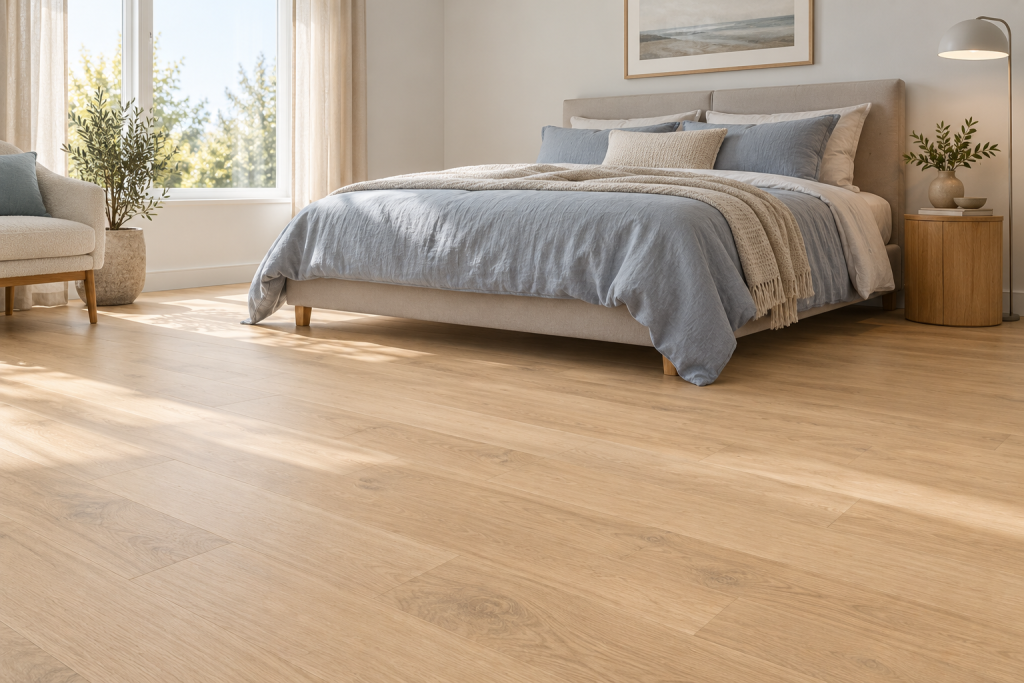
Choose the usage class first, then the thickness. For most homes Floorna recommends AC3 or AC4, which on its Egger labels means boards marked 31 or 32. Laminate flooring thickness then sets how the board feels and how high the floor sits.
How thick is laminate flooring?
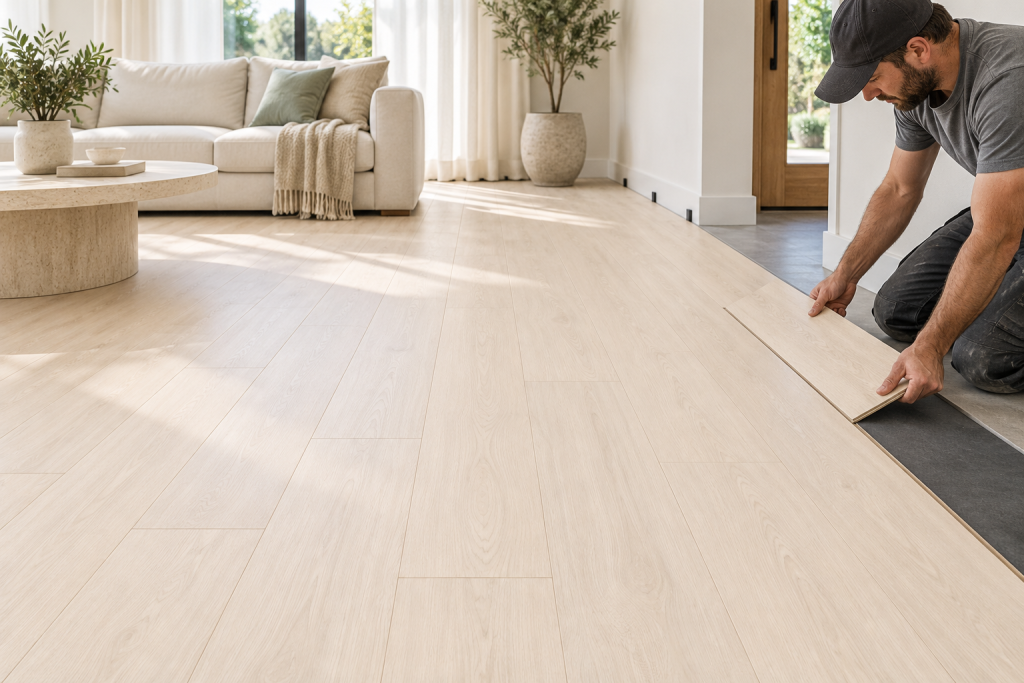
The labels found on Floorna’s Egger pages run from 6mm to 10mm.
Laminate flooring thickness chart: 6mm to 12mm
Floorna’s Egger laminate flooring pages show labels such as 8/32, where the first figure is the thickness in millimetres. The chart records the labels found in the pages reviewed. It is not a statement that Floorna stocks every thickness from 6mm to 12mm.
| Thickness | Labels found on Floorna | Note |
| 6mm | 6/31 (North Cape Oak) | Class 31 |
| 7mm | 7/31 (Falun Oak, Inuvik Oak) | Class 31 |
| 8mm | 8/32 (White Elton Oak), 8/33A+ (White Casella Oak) | Most common among boards reviewed |
| 10mm | 10/32 (White Corton Oak) | Same class 32 as 8/32 |
| 12mm | None found in pages reviewed | Confirm availability and class with Floorna |
How thick is laminate flooring with underlay?
Board thickness and underlay thickness are separate numbers, and the finished build-up is the two added together. For illustration only, an 8mm board on 2mm underlay builds up to 10mm. Use the underlay height the manufacturer specifies.
Does laminate thickness matter?
Yes, for feel and height, but not for wear or water resistance. Floorna’s guide to the types of laminate flooring says AC3 or AC4 suits most homes and that traditional laminate is water resistant rather than fully waterproof. Neither depends on thickness, and laminate flooring thickness does not replace subfloor preparation.
Is thicker laminate better?
Not automatically, because laminate flooring thickness alone does not decide quality. A thicker board feels more solid and sits higher, but it can carry the same class as a thinner one and often costs more. White Corton Oak is 10mm and White Elton Oak is 8mm, yet both carry class 32.
Is thicker laminate better for uneven floors?
No. A thicker board does not make an uneven subfloor acceptable. Egger’s UNIfit instructions (2018 edition, so check the current version) limit subfloor deviation to 2 mm per metre, so the floor must be levelled whatever the board thickness.
Is thicker laminate warmer or quieter?
Thickness alone does not tell you. Warmth and sound depend on the underlay and the whole floor system, so compare tested data for the complete system, not the board millimetres.
8mm vs 12mm laminate: which is better?
Neither is better in every room, because laminate flooring thickness trades solid feel against height. The 8mm board is lower and lighter, while the 12mm board feels more solid but raises the floor. The usage class decides wear, not the millimetres.
| Factor | 8mm | 12mm |
| Feel underfoot | Slimmer board | More solid feel |
| Finished height | Lower, easier at doors | Higher, so check thresholds and clearances |
| Wear class | Set by the label, such as 8/32 | Set by the label, not by thickness |
| Water resistance | Depends on the product | Depends on the product |
| Availability at Floorna | 8/32 and 8/33A+ labels found | None found in pages reviewed |
| Cost | Check the price per m² for the exact board | Check the price per m² for the exact board |
Is 8mm laminate thick enough?
Yes for most homes, provided the class suits the traffic and the subfloor is within tolerance. 8mm laminate flooring is the most common thickness among the Egger boards reviewed on Floorna.
Is 12mm laminate too thick?
Not too thick, but it raises the floor, so check door clearances, thresholds and transitions. 12mm laminate flooring was not found in the Floorna pages reviewed, which does not mean Floorna cannot supply it, so confirm availability and class before specifying.
7mm vs 8mm laminate: what is the difference?
One millimetre of board depth, and sometimes a different class. Floorna’s Egger NatureSense laminate range includes 7mm boards labelled 7/31, such as Falun Oak and Inuvik Oak, and 8mm boards labelled 8/32, such as White Elton Oak, Hamilton Oak and Natural Ortega Oak. The step from 7mm to 8mm also moves the class from 31 to 32.
10mm vs 12mm laminate: is the upgrade worth it?
The only 10mm label found in the Floorna pages reviewed is 10/32, the same class as 8/32, and no 12mm board was found. When two boards share a class, extra millimetres add feel and height, not proven durability.
What thickness of laminate is best for each room?
Start with the room’s traffic and moisture level, then the class, then the thickness. The best laminate flooring thickness is the one whose class suits the traffic, whose height suits the doors and whose price fits the budget. These are suggestions based on labels, not manufacturer guarantees.
Best laminate thickness for bedrooms
A 7mm board labelled 7/31 can be enough for a bedroom with light traffic, if the subfloor meets the manufacturer’s requirements. An 8mm board labelled 8/32 gives a higher class and more margin.
Best laminate thickness for living rooms
For living rooms and hallways, look for class 32 or higher, such as 8/32. Class matters more here than any extra millimetre.
Best laminate thickness for kitchens
Kitchens need moisture resistance more than extra thickness. Floorna’s types guide says kitchens and laundry rooms should have waterproof or moisture-resistant boards. Its comparison of laminate vs SPC flooring describes SPC as waterproof thanks to a stone-based core, while standard laminate is water resistant only on the surface.
Why usage class and AC rating matter more than thickness
Wear resistance comes from the usage class, not the board depth. Floorna’s scratch guide maps the labels 8/31, 8/32 and 8/33A+ to AC3, AC4 and AC5, and describes AC4 as suited to heavy domestic and light commercial traffic. A laminate flooring AC rating tells you how the surface resists wear, which no thickness can change.
How to read labels such as 8/32 and 8/33A+
In a label such as 8/32 the first figure is the thickness in millimetres and the second is the usage class. So 8/32 is an 8mm board of class 32 (AC4 on Floorna’s mapping), and 8/33A+ is an 8mm Aqua+ board of class 33 (AC5).
What thickness underlay should you use for laminate?
Use the underlay the board manufacturer specifies, not the thickest roll available. Laminate underlay thickness is a system decision: Egger’s UNIfit instructions call for a system-specific Egger Silenzio underlay and give no single thickness limit for every product. Underlay also adds to the finished height, and not every underlay is a moisture barrier.
What underlay should you use for 8mm laminate?
Use the underlay specified for that board’s system. Its thickness adds to the 8mm, so check door clearance.
What underlay should you use for laminate on concrete?
On concrete, a mineral subfloor, Egger’s UNIfit instructions call for a moisture film with an SD value of at least 75 m over the whole area, unless a 2-in-1 underlay such as Egger Silenzio Duo or a comparable product is used. Cement screed moisture must not exceed 2 CM%, or 1.8 CM% if heated. Floorna’s page on Egger laminate in Dubai advises acclimatising planks for 48 hours and keeping indoor humidity at 40–60% with air conditioning.
Laminate flooring thickness options at Floorna
Floorna shows Egger laminate labelled 6/31, 7/31, 8/32, 8/33A+ and 10/32 in the pages reviewed, and no 12mm board. That does not mean Floorna cannot supply 12mm, so confirm availability, class and price per m² with Floorna. It also offers up to three free samples dispatched within 24 hours, which lets you judge laminate flooring thickness and build-up in the room itself.
Frequently Asked Questions
Is 12mm laminate waterproof?
No. Thickness does not make laminate waterproof. Check the product data: Floorna describes standard Egger laminate as water resistant, not waterproof, and lists Aqua+ boards as water resistant for 72 hours.
What is the best thickness for waterproof laminate flooring?
No thickness makes laminate waterproof, so choose by the product’s stated water resistance and confirm it suits the room. For bathrooms, Floorna’s Egger laminate FAQ recommends SPC or vinyl.
Is laminate thicker than vinyl?
Often, but it varies by product. The Egger laminate labels reviewed on Floorna run from 6mm to 10mm, while its Bergo concrete finish vinyl tiles are 5 mm thick. Compare the exact products.
Does 12mm laminate need underlay?
Usually yes, unless the board has a built-in underlay or the manufacturer specifies a 2-in-1 system. Follow the instructions for the exact product, and remember that underlay thickness adds to the finished height.