
Total thickness and wear layer are two different measurements, and mixing them up is the most common mistake when comparing vinyl planks. Total thickness is how deep the whole plank is. The wear layer is only the clear top film that takes the traffic. Real figures from two Gerflor ranges show how vinyl flooring thickness and wear layer differ, and which number to check for a kitchen, bathroom or living room.
Vinyl Flooring Thickness vs Wear Layer: Two Different Numbers
The wear layer sits above the printed design and protects it from scratches and scuffs. Total thickness includes everything: wear layer, design layer, core and any attached backing. A thick plank can have a thin wear layer, and a thin plank can have the same wear layer as a thick one.
Gerflor’s own data shows this clearly. Its Virtuo 30 glue-down range lists a total thickness of 2.00 mm and a wear layer of 0.30 mm. Its Virtuo Rigid Acoustic 30 click range lists a total thickness of 5.4 mm and the same 0.30 mm wear layer. The plank is nearly three times thicker, but the nominal wear-layer thickness is the same 0.30 mm, which says nothing about whether the composition, surface treatment or performance match. Seen this way, vinyl flooring thickness is only half the story. Those are different products with different installation methods, so the figures from one must never be applied to the other.
Floorna’s Gerflor LVT flooring category includes the rigid range, such as Sakia (code GV-1118, 229 x 1250 x 5.4 mm). Floorna’s listing confirms Sakia’s total thickness as 5.4 mm. A matching manufacturer sheet is needed to confirm its wear layer; the 0.30 mm figure above belongs to Virtuo Rigid Acoustic 30 and is not confirmed here for Sakia.
What Is a Good Vinyl Flooring Thickness in mm?
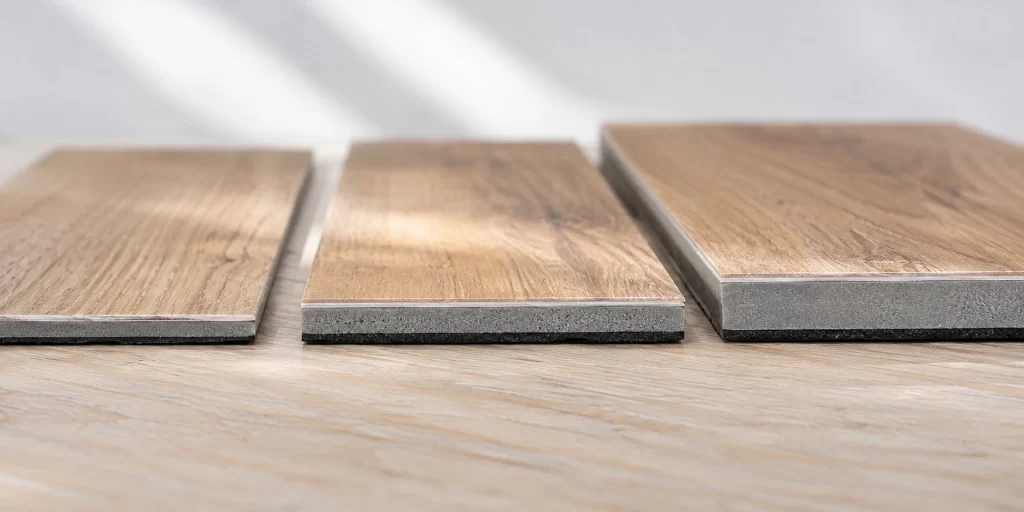
There is no single good number, because vinyl flooring thickness varies widely between ranges, from 2.00 mm for the glue-down Gerflor range above to 5.4 mm and 5.5 mm for the rigid planks Floorna lists. The right figure depends on how the floor is built and where it goes. A glue-down floor is thin and relies on the subfloor and adhesive. A click floor with a rigid core is thicker because the core carries the structure.
Always ask what the quoted number measures. Gerflor reports the Virtuo Rigid Acoustic 30 figure as overall thickness under EN ISO 24346, which means the whole plank. For Bergo, Floorna’s product page for French Oak (code C515, 1520 x 228 mm) lists 5.5 mm, but the page does not say whether an attached backing is included or what the wear layer is. Browse Floorna’s Bergo rigid LVT flooring range and request the data sheet before you compare it with another plank.
Thicker is not automatically better. Thickness changes the finished floor height, which matters at doors and thresholds, and it interacts with the subfloor. Gerflor states that Virtuo 30 glue-down needs a clean, flat, even, dry and sound substrate, while the Sakia click plank is listed as suitable for installation over tiles. The method, not the number alone, decides what the floor can hide. Sakia is also listed as compatible with hot-water underfloor heating, another system detail that the millimetres do not reveal. If your project involves heating, a tiled base or a very uneven slab, say so when you ask for a quote, because those conditions change which construction is appropriate.
Wear Layer Thickness: How to Read mm and mil
Vinyl flooring wear layer thickness is quoted in millimetres on European data sheets and often in mil in US listings. One mil is 0.0254 mm, so Gerflor’s 0.30 mm is about 11.8 mil. If you see a plank quoted in mil, convert it before comparing: 20 mil is about 0.51 mm.
Do not treat the conversion as a quality ranking, and do not read vinyl flooring thickness as a grade. Wear layer figures are measured under a standard, and a bigger number only helps if the product also suits the traffic. Gerflor’s page for the glue-down Virtuo 30 range lists classes 23 (domestic) and 31 (commercial) under EN ISO 10874. That statement covers the glue-down range only, and Floorna’s Sakia page quotes a different classification from Gerflor’s own rigid data sheet, so this guide uses neither for Sakia; ask for the class of the exact product. Classes tell you the intended use better than the millimetres do.
A thicker wear layer lasts only if you protect it. Strong chemicals and rough tools wear any finish, so follow Floorna’s guidance on how to clean vinyl flooring for a routine that does not dull the surface.
Kitchens and Bathrooms: What Thickness Does Not Tell You
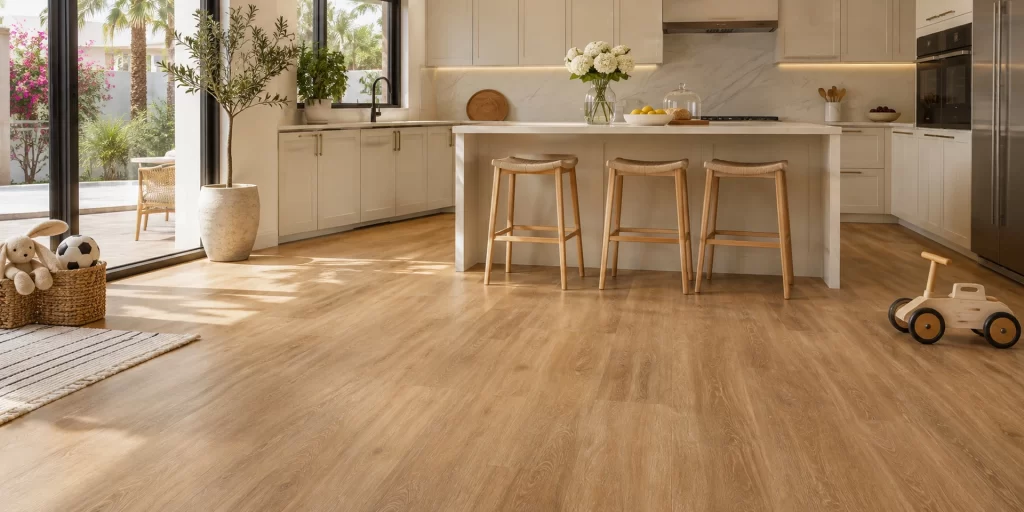
For vinyl flooring thickness for kitchen use, the question is less about total depth and more about indentation. Gerflor lists a residual indentation of 0.10 mm or less for Virtuo Rigid Acoustic 30, tested under EN ISO 24343-1, which is a more relevant figure for heavy appliances than the plank depth.
For vinyl flooring thickness for bathroom use, thickness alone does not prove the floor is suitable. Floorna’s Sakia page describes moisture resistance and lists kitchens and bathrooms among its applications, but a bathroom floor also depends on the core, the sealed edges, the subfloor and how water is managed around the shower. Ask the supplier for the maker’s wet-area guidance for the exact product.
If you are weighing a rigid core against a flexible plank, Floorna’s comparison of spc vs vinyl flooring explains how the constructions differ. The same logic applies to laminate, where board depth also says little about wear; see Floorna’s guide to laminate flooring thickness.
A Practical Checklist for Comparing Quotes
Use this vinyl flooring thickness guide as a short checklist when you compare quotes.
- Start with the use class and the room, not the millimetres.
- Check the wear layer separately, in mm, and note the standard it was measured under.
- Ask what the total thickness includes, such as backing or attached underlay.
- Match the thickness to the system: glue-down or click, and what the subfloor allows.
- Measure the door clearance and transitions with the finished height.
Done in that order, vinyl flooring thickness becomes one input among several, not the headline number.
Comparing planks for your own room? Send your room details and the subfloor type to Floorna and ask the team for the data sheet of the exact plank you are considering.
Frequently Asked Questions
1. Is a thicker plank always more durable?
No. The wear layer is a separate figure, and a thick plank can have a thin one. Thickness also changes the finished floor height at doors and thresholds, and the installation method and subfloor matter as much as the number.
2. How do I convert a wear layer from mil to mm?
Multiply by 0.0254. For example, 10 mil is about 0.25 mm, so a figure quoted in mil should be converted before you compare it with a data sheet in mm.
3. Which figure should I check first for a busy room?
Start with the use class and the room, then check the wear layer in mm and the standard it was measured under. For kitchens, indentation matters too; Gerflor lists 0.10 mm or less for Virtuo Rigid Acoustic 30.