The safest way to clean laminate floors is dry first, then barely damp. Sweep or vacuum the grit, wipe with a well wrung microfibre mop, and dry whatever moisture is left behind. Streaks often come from too much water or too much cleaner, not from too little effort. Learning how to clean laminate floors in a UAE home is mostly about protecting the joints, so the sections below cover why residue appears, where vinegar, steam and wax fit in, and how to tell dirt from scuffs and edge damage.
How to Clean Laminate Floors Without Damaging Them: A Routine to Follow
The best way to clean laminate floors is also the driest one. Standard laminate is not waterproof, so the routine is built to keep water off the joints.
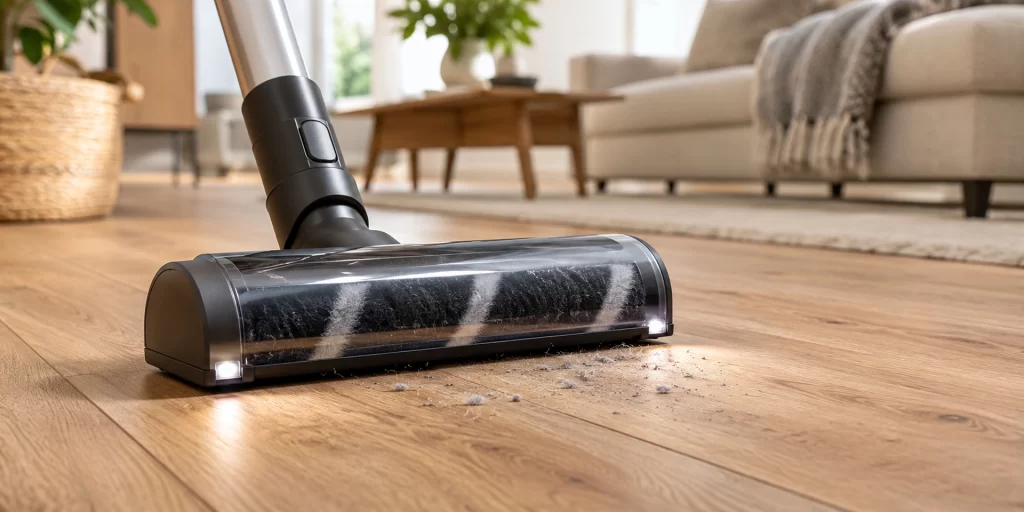
- Remove grit first. Use a soft-bristled broom or a vacuum with a soft brush head. EGGER advises taking off rotating brushes, which can damage the surface.
- Mop with a microfibre mop that is damp, not wet. Wring it out hard, or mist the floor lightly from a spray bottle of clean water and wipe it over.
- Check the floor as you finish each section. If it still looks wet, you used too much water; EGGER’s 2-step wiping method asks you to absorb excess cleaning liquid promptly, within 5 minutes.
- Dry any remaining moisture with a clean microfibre cloth, especially along the joints and edges.
Clean spills as they happen, and keep grit out. Sand tracked in on shoes acts like sandpaper, so a doormat at each entrance helps. Good habits matter as much as products when you learn how to clean laminate floors: use felt pads under furniture and lift chairs rather than dragging them.
For routine cleaning, EGGER’s care instructions call for damp mopping with a non-film-forming floor cleaner at the dosage its maker gives, and its blog names a laminate-specific cleaner or mild soap and water. Avoid abrasive cloths, scourers, hard-bristled brushes and harsh chemicals.
What Is the Best Way to Clean Laminate Floors Without Leaving Streaks?
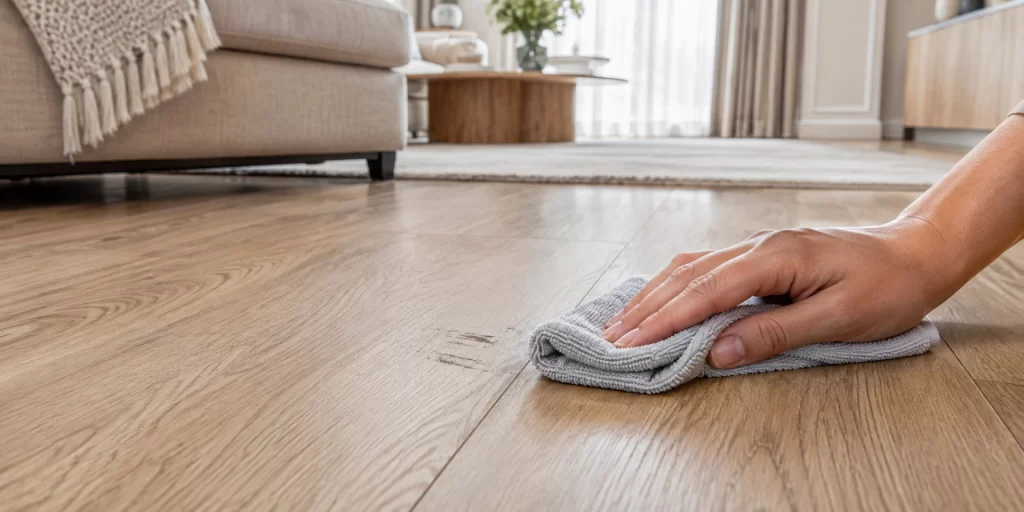
Streaks and cloudy patches are usually residue. Common causes include too much cleaner, too much water, and a dirty mop head that spreads dirt around. EGGER notes that some cleaners build up into a film over time, and general cleaning guides make the same point about using more cleaner than the label recommends.
To fix a streaky floor, do not add another product. Wipe a small area with a cloth dampened in clear water, then buff it dry with a clean microfibre cloth in the same pass. Wash the mop pad or cloth whenever it is visibly dirty. If you use a laminate cleaner, follow the maker’s dosage, and change the pad when it is dirty.
If the floor still looks wet after mopping, the answer is not a stronger cleaner. Use less liquid and dry as you go. A wetter mop feels more thorough, but it is the riskier choice, and it is the habit that most undermines any routine for how to clean laminate floors.
Vinegar, Steam and Wax: What the Maker Says
People searching how to clean laminate floors with vinegar usually want a cheap fix for dull or streaky boards. Vinegar is better treated as a spot treatment than a mopping solution. EGGER’s blog mentions a mix of water and white vinegar for stubborn marks such as coffee, red wine or grease, while naming a laminate-specific cleaner or mild soap and water as the normal choices. Its care instructions give no mixing ratio and say most cleaners, vinegar included, work best in cold water, so follow the dosage on whatever product you use. Test a hidden corner first and wipe the area dry afterwards so nothing sits in the joints.
Steam is where product type matters. EGGER’s care instructions say steam cleaning is generally not permitted and approve it only for its NatureSense Aqua+ and AquaDura+ ranges, with the steam cleaner kept in constant motion and filled with clear water only, no cleaning products or additives. Floorna lists Natural Casella Oak Aqua+ (code EL2152, 1292 x 246 mm, classified 8/33A+), and the product page says it is water-resistant for 72 hours. The name and decor code do not by themselves confirm the EGGER range, so check the care sheet for that exact board before using steam. Water resistance for 72 hours is a time-limited claim, not a licence to leave water on the floor. Wording on “waterproof” differs between brands, so read Floorna’s guide to waterproof laminate flooring and the care sheet for your exact board before changing the method.
Wax and polish are best avoided. EGGER’s care instructions state that waxing and polishing are not permitted, and its blog notes they can leave a slippery film.
Getting a Brighter Look Without Polish
If you want to know how to clean laminate floors to shine, the honest answer is that cleaning removes the film that dulls the surface, but it cannot change the finish the boards were made with. A matt or textured decor stays matt. A floor that looks flat after a deep clean may simply be showing its real finish.
For the best result, mop lightly, then buff dry with a clean microfibre cloth. Do not apply polish to raise the gloss. That trades a short-lived shine for a residue you will then have to remove.
Is It Dirt, a Scuff, a Scratch or Edge Damage?
The right method depends on what you are looking at, and how to clean laminate floors safely starts with naming the problem correctly.
Dirt and spills lift with a damp microfibre cloth, and that is the simplest case. Sticky residue such as gum or wax can be hardened with an ice pack and lifted with a plastic scraper rather than a metal blade.
Scuff marks sit on the surface, usually from shoe soles or furniture feet. They need a targeted method rather than more mopping, so follow Floorna’s guide on how to remove scuff marks from laminate flooring.
Scratches cut into the printed surface. A cleaner will not remove them, and scrubbing will make the area look worse.
Swollen edges and lifted joints point to moisture that has already entered the board. Cleaning cannot reverse that. Stop using water on the area and ask the installer or supplier to inspect it. Separate gaps between planks are a different issue that is usually about movement and installation, which Floorna covers in its guide to gaps in laminate flooring.
A Simple Maintenance Rhythm
EGGER’s guidance is to vacuum laminate at least once a week and to damp mop it at least once every two months. High-traffic areas such as hallways, and homes with pets, may need vacuuming more often, and the care instructions for your exact floor come first. Keep the method the same and change only the frequency. The answer to how to clean laminate floors is a consistent, low-moisture habit rather than a special product list.
Replacing tired boards or planning a new floor? Browse the Egger laminate flooring range at Floorna and send the team your room size and usage, and they will help you match a board class and finish to the space.
Frequently Asked Questions
1. Can I use a steam mop on laminate?
Only if the maker allows it. EGGER’s care instructions say steam cleaning is generally not permitted and approve it only for its NatureSense Aqua+ and AquaDura+ ranges, with the mop kept moving and filled with clear water. Check the care sheet for your exact board first.
2. What should I avoid using on laminate?
Avoid wax, polish, abrasive cloths, scourers, hard-bristled brushes, harsh chemicals and rotating vacuum brushes. Also avoid soaking the floor, because standard laminate is not waterproof and water that reaches the joints can swell the boards.
3. How often should laminate floors be cleaned?
EGGER advises vacuuming at least once a week and damp mopping at least once every two months. Vacuum more often in high-traffic areas such as hallways or if you have pets, and follow the care instructions for your exact floor.