No floor is fall-proof, but some are tested for grip and some are not. Slip resistant flooring is a floor with a measured result from a recognised slip test, ideally for the conditions where you will use it: wet or dry, shoes or bare feet. Reading the ratings correctly is the first step; after that, the right choice changes between a bathroom, a kitchen, a staircase and a terrace, and a supplier’s documents count for more than a “non-slip” label.
Slip Resistant Flooring Rating: R Values, PTV and DCOF Explained
Three different tests are used, and their numbers cannot be converted into one another.
The R rating (R9 to R13) comes from the German ramp test, DIN 51130. According to the German accident insurers’ guidance, a test person walks forwards and backwards on an oiled floor covering while the ramp is tilted until they begin to lose footing. R9 has the lowest requirement and R13 the highest. It is a shod-foot test.
The pendulum test gives a Pendulum Test Value (PTV), and HSE says it uses the pendulum in both dry and contaminated conditions. HSE’s information sheet classes a PTV of 36 or more as low slip potential and 0 to 24 as high, but the result depends on test conditions: the slider (Slider 96 for shod pedestrians, Slider 55 for barefoot areas), wet or dry surface, and a trained operator. It describes the floor as tested, not a guarantee against falls. This is UK guidance, not UAE law.
DCOF, the dynamic coefficient of friction, is measured under the American ANSI A326.3 standard. In the 2021 edition, TCNA’s FAQ lists five use categories: Interior Dry and Interior Wet carry a 0.42 requirement (Interior Wet can alternatively be manufacturer-declared), while Interior Wet Plus, Exterior Wet and Oils/Greases are manufacturer-declared. TCNA adds that DCOF helps compare surfaces but does not predict whether a slip will happen, that the value must not be the only factor in judging suitability, and that the classifications do not address ramps or inclined surfaces.
Barefoot areas use separate classes. Gerflor lists R10 to R12 for wet shod use and B and C classes for wet barefoot use in its safety ranges. A single slip resistant flooring rating therefore describes one test condition, not the whole floor.
Gerflor’s data sheet for Virtuo Rigid Acoustic 30 gives R10 (DIN 51130) as the result for that range and lists no barefoot class. R10 is the second step on the R9 to R13 scale. Floorna lists a Virtuo 30 Rigid range, but its Sakia page states no slip rating and does not confirm that the sheet covers the same version and code, so treat R10 as the documented result for the Gerflor family and ask Floorna to confirm it for the exact product before relying on it. You can browse the range under Gerflor LVT flooring.
Slip Resistant Flooring for Bathroom Use: Showers and Wet Zones
A bathroom is several different surfaces, so choosing slip resistant flooring means matching each zone to a test. Outside the shower you step with wet feet or socks; inside it you are barefoot with soap on the floor. Slip resistant flooring for bathroom use should therefore be checked for wet barefoot performance, not just a shod-foot R value.
Texture alone does not guarantee grip, and “waterproof” describes what water does to the floor, not how it behaves underfoot. A waterproof plank can still be slippery when wet. Soap film and some cleaning products can change grip over time, which is why one flooring maker advises that healthcare floors have their slip levels checked at regular intervals.
For a shower floor, ask for a wet barefoot test. For the rest of the room, ask for the slip documents of any product you shortlist, including Floorna’s Bergo rigid LVT flooring range. The product pages list size, thickness and colour tone, not a slip rating, so request the report before treating any rigid vinyl as suitable for a wet room. Floorna’s guide to the best flooring for bathroom compares materials.
Kitchens: Spills, Grease and Cleaning Habits
For slip resistant flooring for kitchen use, separate a home kitchen from a commercial one. Gerflor’s safety range lists collective kitchens as one of its intended uses, where grease and wet cleaning are routine. A domestic kitchen has lighter loads but the same hazards: oil, water and fine sand carried in on shoes.
In a kitchen, slip resistant flooring is as much about habits as about the product. Grip also depends on how you clean. EGGER warns that wax and polish can leave a slippery film on laminate, and the same logic applies to any floor: a residue changes the surface that was tested. Use the cleaner the maker recommends and dry the floor after mopping. HSE also cautions that manufacturer friction data usually describes the product as supplied, not after installation, cleaning or wear.
Stairs Need More Than a Floor Rating
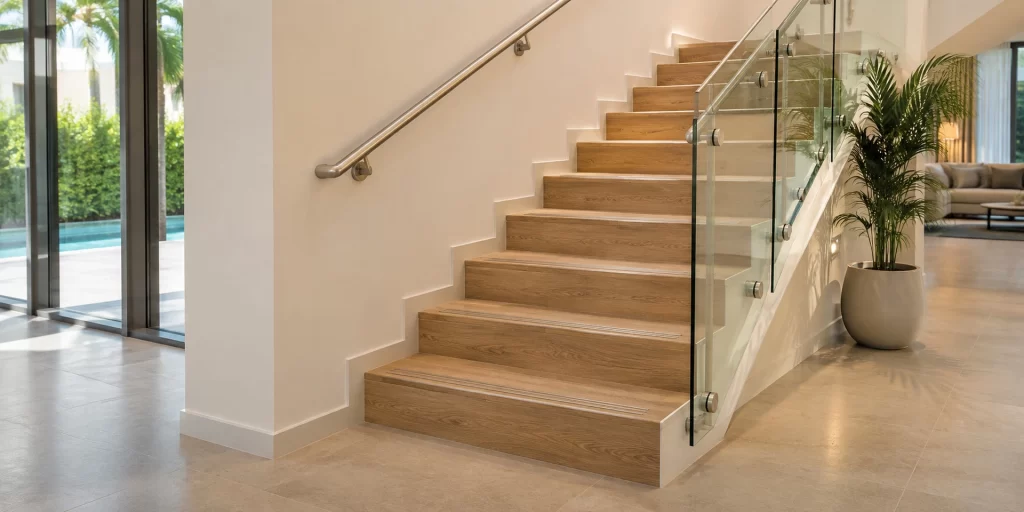
Slip resistant flooring for stairs has an extra problem: the edge. A rating describes a flat surface under test conditions, not the stair nosing where your heel and toe meet the step. Check the nosing detail, the finish on the tread and whether the product is approved for stairs by its maker.
Floorna’s guide to the best flooring for stairs covers materials and safety points in more depth. If a supplier cannot show stair approval for a product, choose another.
Seniors and Pets: What a Floor Can and Cannot Do
Many people hope non slip flooring for seniors will prevent falls. It cannot. Slip resistant flooring is one layer of protection. A tested surface reduces one risk, but balance, footwear, lighting, loose rugs and thresholds matter as much. Choose a floor with a documented result, keep it dry and free of residue, and avoid abrupt level changes. A care professional can advise on a home assessment.
Households with animals ask a similar question about grip. Floorna’s guide to the best flooring for pets covers scratch and stain resistance, and the same rule applies: ask for test data, not adjectives.
Outdoor Areas: Choose the Right Product and Check the Report
For anti slip flooring outdoor, start with a product made for outdoor use. The Bergo page on Floorna describes its rigid vinyl for indoor spaces, so do not take indoor vinyl onto a terrace or balcony. Outdoor decking is a separate product category; Floorna lists WPC decking for outdoor use. Surface texture, sun, splashes and pool water all change grip, so ask for a wet pendulum or ramp test report for the exact decking board and note the conditions it was tested under.
What to Ask a Supplier?
If a product has no documented result, do not assume one. Ask for the test report for the exact product, the method (R rating, PTV or DCOF), whether it was wet or dry, shod or barefoot, and the lab and date. For commercial or public projects, ask your consultant which standard applies in the UAE. Any slip resistant flooring claim without that paperwork is only a sales line.
Need a floor for a wet or high-traffic area? Ask the Floorna team for the data sheet and slip test report of the exact product before you order.
Frequently Asked Questions
1. Does a waterproof floor mean it is slip resistant?
No. A floor can resist water and still be slippery when wet, because the two properties are tested separately. Ask for a slip test result for the exact product.
2. Is a higher R value always safer?
A higher R class means a higher requirement in the oiled-ramp test, which is a shod-foot test. It does not convert into a pendulum or DCOF result and says nothing about barefoot use, so read it as one test condition.
3. Can a floor be tested for barefoot areas?
Yes. HSE’s pendulum method uses Slider 55 for barefoot areas, and Gerflor lists B and C classes for wet barefoot use in its safety ranges. Ask which test and which class a product’s report covers.