
How to clean WPC decking comes down to a soft brush, warm soapy water and a good rinse. The method is gentle, but UAE conditions add sand, dust, pool splashes and strong sun, so the routine matters. This guide covers the tools, the steps, safe cleaners and stain fixes, and shows what to avoid so you protect the boards and their warranty.
How do you clean WPC decking?
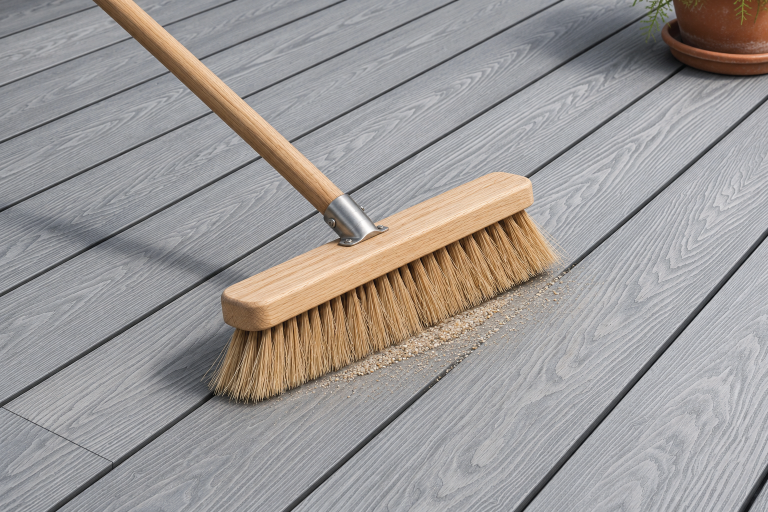
Sweep off loose dirt, wash with warm water and a mild soap using a soft brush, scrub along the grooves and rinse thoroughly. That simple routine handles most dirt. Work with the board grain, and never use harsh chemicals or hard bristles.
How often should you clean WPC decking in the UAE?
A light sweep once or twice a week and a full wash every month or two suits most homes. Decks near pools, under trees or in dusty areas may need washing more often. Floorna’s guide to WPC decking in Dubai lists low maintenance and easy cleaning among its main benefits, so a short routine is enough. After a sandstorm, rinse the surface as soon as it is practical, because grit trapped in the grooves scratches under foot traffic.
What do you need to clean WPC decking?
Good WPC decking maintenance needs very little equipment, and most of it is already in the house.
- A soft broom for sweeping
- A hose or bucket of clean water
- A soft bristled deck brush
- Mild dish soap or a cleaner approved for composite boards
- Microfibre cloths or a soft mop for drying
- A grease absorbing powder or cloth for spills
How to clean WPC decking step by step
Follow this order every time, working one section at a time, so you remove dirt without scratching the boards.
1. Sweep away sand and dust
Brush along the length of the boards and into the gaps. Removing sand first prevents it grinding into the surface while you scrub.
2. Wash with warm soapy water
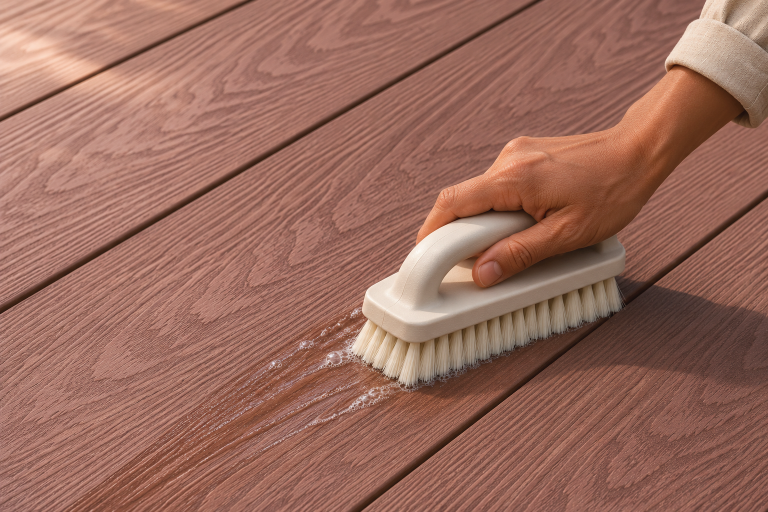
Mix a little mild soap into warm water, apply it with a soft brush or mop and let it sit for a few minutes. Dura’s care guide recommends warm soapy water and a soft bristled brush for its composite boards. Floorna’s DuraDeck ECO boards are made by Dura, so this is the routine to follow.
3. Scrub along the board grooves
Scrub in the direction of the grain and along the grooves, where dirt collects. Light pressure is enough, and a hard brush can scuff the surface.
4. Rinse and let the deck dry
Rinse well with clean water so no soap film remains, then let the deck dry in the shade or early morning. Soap left to bake in the sun can leave marks.
Can you pressure wash WPC decking?
Yes, with care. Can you pressure wash composite decking? It depends on the manufacturer. Dura’s guide for its own boards allows pressure up to 1,500 psi, a nozzle at least 15 cm from the surface and no more than three seconds on one spot. These limits cover Dura boards, including the DuraDeck ECO range Floorna supplies. Going beyond them can damage the surface and may affect the warranty.
What cleaner is safe for WPC decking?
For routine washing the best cleaner for WPC decking is warm water with mild dish soap. For stubborn marks, use a cleaner the board manufacturer approves. As one of the best WPC decking suppliers in Dubai, Floorna can recommend a product suited to your board. Always test any new product on a hidden spot first.
Which chemicals should you avoid?
Avoid chlorine bleach, strong acids, solvents, abrasive powders and steel wool. Dura’s manual says not to use bleach on its boards because it lightens the colour. These products can discolour or damage the surface.
How do you remove common stains from WPC decking?
To remove stains from composite decking, act quickly and match the method to the stain.
Grease and food stains from barbecues
Mop up oil and grease immediately, then wash with warm soapy water. Dura advises dealing with oil promptly because it is harder to remove once it sets.
Rust marks from furniture
Rust stains need a cleaner made for them, such as an oxalic or phosphoric acid product, according to Dura’s guidance. Test it on a hidden spot first, avoid bleach, rinse well afterwards and move metal furniture off the boards or use pads under the feet.
Water spots and chlorine residue near pools
Near a pool, rinse splashes with fresh water and wash with mild soap. Regular rinsing helps stop mineral spots building up, and Dura notes that stubborn water spots can be pressure washed within the limits above.
Mould and algae in shaded corners
Shade and damp let mould grow even on composite boards. Scrub with warm soapy water, improve airflow and keep drainage clear. Avoid bleach, which lightens the boards.
How do you fix scratches on WPC decking?
Light scratches usually fade as the surface weathers, and Dura notes that most marks blend in after about 12 weeks. For a stubborn mark that cleaning and pressure washing cannot shift, Dura allows light sanding with 22 to 60 grit paper to a maximum depth of 0.5 mm. Individual boards in a clip system can also be replaced, so keep a few spare boards from the WPC decking collection after installation.
Do you need to oil, seal or stain WPC decking?
No. Floorna’s decking pages state that its boards need no staining, sealing or painting. That is a major reason people choose WPC over timber. Sealers can trap dirt or flake, so avoid them unless the manufacturer asks for one.
How do you protect WPC decking from fading and sand damage?
Choose a UV stable board, expect some lightening in the first three months as the boards weather and sweep sand away before it grinds in. Place mats at doors and use felt pads under furniture. On balconies, drainage and surface choice matter too, as the balcony flooring ideas guide explains.
WPC decking vs wood decking maintenance
| Task | WPC decking | Wood decking |
|---|---|---|
| Oiling or sealing | Not needed | Regular, often yearly in strong sun |
| Staining or painting | Not needed | Needed to keep colour |
| Routine cleaning | Sweep and wash with mild soap | Sweep, wash and treat mould |
| Splinters and rot | Resistant | Can develop over time |
| Fixing damage | Sand light marks, replace boards | Sand, refinish or replace |
Low maintenance WPC decking from Floorna
Floorna supplies and installs DuraDeck ECO decking from Dura in Stone (P64) and Teak (P4D), boards that need no oiling, sealing or staining. Care follows the routine above: sweep, wash with mild soap, scrub along the grain and rinse. Ask Floorna for the Dura care sheet when you order, and request a free sample to see the finish first.
Frequently Asked Questions
Can you use bleach on WPC decking?
No. Dura’s manual says not to use bleach because it lightens the boards, and Floorna recommends mild soap and water for routine cleaning.
How do you clean WPC decking after a sandstorm?
Sweep off the loose sand, then rinse with plenty of water and wash with mild soap and a soft brush. Rinse again so no grit is left in the grooves.
Does WPC decking get mouldy?
It can in damp, shaded spots, although it resists rot. Wash regularly, improve airflow and keep drainage clear.
Can you use vinegar on composite decking?
Vinegar is not among the cleaners Dura lists for its boards. Use warm soapy water for routine cleaning and, for engrained marks, a cleaner containing oxalic or phosphoric acid tested on a hidden spot first.