Ask two flooring guides whether dark or light floors hide dirt better and you will get opposite answers. Both are right, and neither is useful, because they answer for a climate that is not yours. Here is how the dark vs light hardwood floors question resolves in the UAE.
Quick answer: in the UAE, light and mid-tone floors are the more practical choice for most homes, because the dominant airborne particle here is pale sand. Dark floors remain excellent in low-traffic, well-shaded rooms, and a matte finish removes most of the maintenance objection against them.
A note on terminology: in the UAE, “hardwood floors” is used loosely to cover engineered wood, laminate and wood-effect luxury vinyl. All three are covered below, because colour behaves differently in each.
The Dust Question Everyone Answers Wrong
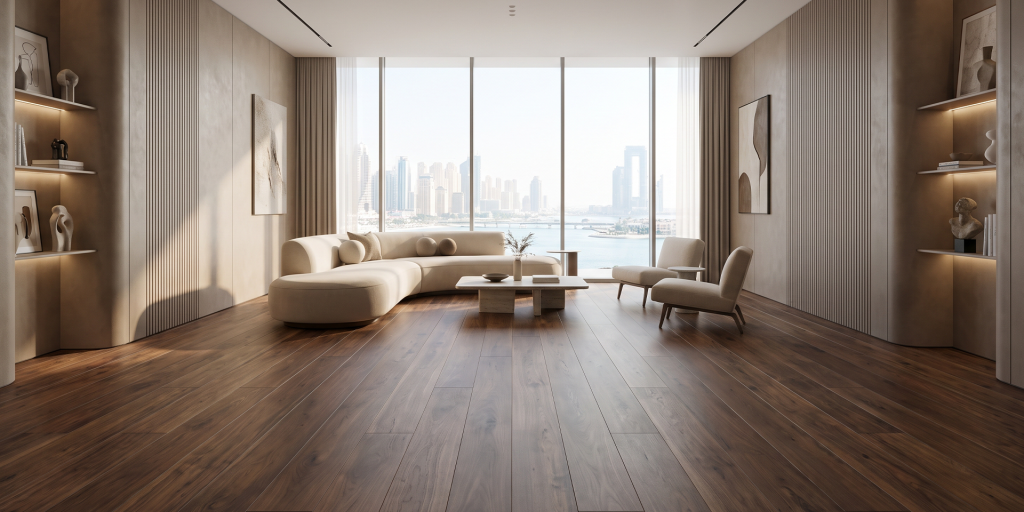
A floor does not hide dirt in the abstract. It hides dirt of a similar colour to itself. Dark walnut hides dark soil and mud; pale oak hides light dust and pale grit.
So the real question is not which colour hides more. It is: what actually lands on your floor?
In the UAE the dominant contaminant is fine, pale, wind-carried sand. It settles daily even in sealed apartments and acts as a natural abrasive underfoot. That single fact tilts the practical answer toward lighter tones in most Emirati homes.
Dark vs Light Hardwood Floors: Does the Material Change the Answer?

Yes. Each of the three wood-look constructions carries its colour differently, and that changes the answer.
Engineered wood carries a stain on a real hardwood veneer, so the tone shifts with age and light, and scratches expose paler timber beneath. Dark stains show those pale lines most clearly. Construction and suitability are covered in the Engineered Wood Flooring Dubai guide.
Laminate carries a printed decor layer under an aluminium oxide wear layer, so it does not fade the way a surface stain does, and damage shows as scuffing rather than exposed pale wood.
Wood-effect luxury vinyl carries a printed film under a transparent wear layer, so fading depends on UV stabilisation rather than on how dark the shade is.
Most traditional dark vs light hardwood floors advice was written about solid timber and does not transfer cleanly to these constructions.
Fading Under UAE Sunlight
Imported guidance on dark vs light hardwood floors contradicts itself here: some sources insist dark fades faster, others insist light does. For real wood both change, but differently. A dark stain fades unevenly, leaving lighter patches where sunlight lands hardest. A pale floor shifts subtly, so the change reads as ageing rather than damage. That matters where floor-to-ceiling glazing is standard and solar exposure far exceeds the markets most flooring content is written for.
For laminate and vinyl the question shifts to specification: check UV stability rather than assuming a dark colour will hold. Materials are compared in the Engineered Wood vs Laminate in UAE guide.
Undertones Matter More Than Light or Dark
Most people frame dark vs light hardwood floors as one choice and stop there. Professionals choose an undertone, which is why two pale oak floors can look completely different in the same room.
Warm undertones carry yellow, gold or red, and pair with brass, cream and warm marbles. Cool undertones carry grey or ash, and pair with chrome, white and grey marbles. Neutral greige tones sit between the two, are the most forgiving across changing light, and are widely specified in new Dubai developments.
Naming the undertone before you shop prevents the most common mismatch in UAE homes: a cool grey floor fighting a warm beige marble.
Matching Your Floor to Existing Marble
This is the question local homeowners actually face, and it is almost absent from international advice. Most UAE properties retain marble in entrances, bathrooms or staircases during renovation, so the new floor has to live beside it. Three approaches work.
Match the undertone, not the colour. Warm beige marble sits comfortably with a warm oak floor even if the shades differ; the clash comes from opposing undertones, not different tones.
Commit to deliberate contrast. Deep walnut against pale marble reads as intentional when the contrast is strong; a near-miss reads as a mistake.
Use a neutral bridge. Greige sits beside almost any marble because it carries both warm and cool notes.
The same logic applies to skirting and door frames: match them for a seamless room, or contrast them deliberately.
Pros and Cons of Dark vs Light Hardwood Floors
The pros and cons of dark vs light hardwood floors come down to this.
Light and mid-tone floors hide pale sand between cleans, make apartments feel larger, disguise fine scratches and carry broad resale appeal. Against that, they show dark spills more readily and can look flat in very large rooms without texture.
Dark floors deliver depth and a formal presence, frame light furniture beautifully and hide dark staining. Against that, they show dust, footprints and pale scratch lines clearly, fade unevenly in stained wood, compress smaller rooms, and are more polarising at resale.
Colour rarely changes the price: within a collection, pale oak and deep walnut usually cost the same per square metre, so this is about performance and taste, not budget. For these tones in finished projects, see the Wooden Flooring Dubai range.
Two Factors That Outweigh Colour
Finish
Gloss reflects light, magnifying dust, footprints and every fine scratch, and on a dark floor under strong daylight that effect is severe. Matte and textured finishes scatter light and disguise the same particles, which is why matte is increasingly specified across UAE projects. If you want dark, choose matte: that one decision removes most of the maintenance objection.
Plank Width
Narrow planks create more visible joint lines, and on a dark floor those lines add busyness and make a room feel tighter still. Wide planks show fewer joints, so a dark floor reads as a calm, continuous surface. If you want dark in a smaller room, go as wide as the budget allows.
Dark vs Light Hardwood Floors: A Room-by-Room Guide
Entrances and hallways: light or mid-tone, matte. These take the most sand.
Living rooms: either works; large, well-lit spaces carry dark tones best, especially in wide planks.
Bedrooms: dark performs well, since traffic is low and the drama is welcome.
Kitchens: mid-tone, matte, with genuine moisture resistance. Both extremes show marks here.
Small apartments: light throughout in one continuous tone, which reads larger and avoids breaks at every doorway.
Homes with pets: match the floor to the pet’s coat, not the trend. Claw marks are the bigger issue, appearing as bright lines on dark stained wood and blending readily into lighter tones.
Test the Colour Before You Commit
Showroom lighting is not your lighting. Take samples home, lay them on the floor rather than holding them up, and view them morning, midday and under artificial light at night. UAE daylight is intense and directional, and a sample that looks warm at noon can read grey by evening.
Place it against your existing marble, skirting and largest piece of furniture at once. Judging dark vs light hardwood floors in isolation is what produces mismatches.
Choosing Your Floor Colour With Confidence
The dark vs light hardwood floors question has no universal answer, but it does have a local one.
Work in this order: start with what lands on your floor, match the undertone to what is already in the room, choose a matte finish, set the plank width to the room size, and only then pick the shade you love.
For samples viewed in your own light and advice on dark vs light hardwood floors for your rooms, Floorna supplies and installs across Dubai and the UAE.
Frequently Asked Questions
Do dark or light floors hide dust better?
It depends on the colour of the dust. In the UAE the dominant particle is pale sand, so light and mid-tone floors hide daily soiling better.
Which is easier to maintain?
Light and mid-tone in a matte finish need the least frequent cleaning here. Dark gloss is the most demanding combination.
Do dark floors show scratches more?
On stained wood yes, because a scratch exposes paler timber and creates a bright line. On laminate and vinyl the contrast is lower, since the colour sits under a protective layer.
Do dark floors make a room look smaller?
They compress small or low-light rooms, particularly with narrow planks. In large, brightly lit rooms they add depth instead.
Which fades faster in UAE sunlight?
Stained dark wood fades unevenly and visibly; pale wood changes more subtly. For laminate and vinyl, UV stability matters far more than the shade.
What colour has the best resale appeal in Dubai?
Neutral greige and light oak tones have the widest appeal. Very dark floors are stylish but polarising, which can narrow the buyer pool.