
A balcony in Dubai is not a balcony in London. It is a slab of bare concrete sitting in direct sun for eight months a year, blasted by sand, then flooded every time the building washes the facade. Most balcony flooring ideas online were written for temperate climates, which is why so many fail here within one summer. The good news is that a handful of materials genuinely handle these conditions, and the right one turns a wasted square of concrete into the best seat in the apartment. This guide covers seven options that survive, what each costs in maintenance, and where each belongs. At Floorna, the rule is simple: match the material to the environment first, then choose how it looks.
What Dubai Actually Does to a Balcony Floor?
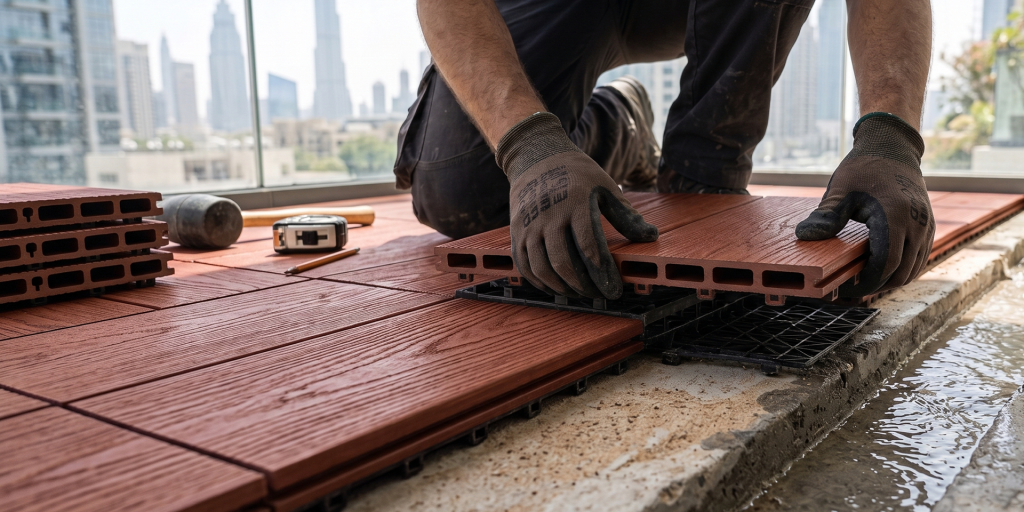
Before you pick anything, understand what you are specifying against.
1. Heat, UV and Surface Temperature
Ambient air hits the mid-forties, but the surface underfoot climbs far higher. Dark, dense materials store that heat and radiate it back into the evening. Constant UV also fades and chalks anything not properly stabilised, which is why cheap imported boards look grey within two seasons.
2. Water, Sand and Drainage
Balconies are washed, rained on occasionally, and covered in fine airborne sand constantly. Whatever you lay must let water reach the existing drain. Blocking the fall of the slab is the single most common installation mistake, and it turns into standing water, then staining, then a complaint from the neighbour below.
3. Rules Your Building May Impose
Most towers will not allow you to bond anything permanently to the balcony slab, because the waterproof membrane underneath must stay accessible. This is exactly why dry-laid, liftable systems dominate the market here and why permanent wet trades are often refused outright. Check with facilities management before you buy anything.
7 Balcony Flooring Ideas That Survive a Dubai Summer
These are the balcony flooring ideas that cope with everything above, ranked by how well they hold up.
1. WPC Decking Boards
Wood plastic composite is the default answer for good reason. It combines wood fibre with polymers, so it delivers the look of timber without rotting, warping or splintering, and it is UV stabilised against fading. Boards sit on an adjustable joist substructure, which lifts the surface off the slab, preserves the drainage fall and hides uneven concrete at the same time. Our WPC Flooring range is built specifically for Gulf exposure rather than adapted to it.
2. Interlocking WPC Deck Tiles
If you want the same material without a joist system, balcony flooring tiles are the answer. They clip together over the existing slab with no screws, no adhesive and no contractor, and they lift out in an afternoon if you move or if the building needs access to the membrane. For renters, this is the most sensible of all the balcony flooring ideas here. Dura Deck tiles interlock directly and stay colour stable under sustained sun.
3. Porcelain Paving
Outdoor-grade porcelain is dense, does not absorb water and resists staining well. Twenty millimetre pavers can be dry-laid on pedestals over the slab. The trade-off is weight and surface temperature, since a dark tile becomes genuinely uncomfortable underfoot by mid-afternoon. Choose a light tone and a textured, slip-rated finish.
4. Natural Stone
Travertine and light limestone stay cooler than most surfaces and look expensive because they are. The catch is porosity. Stone needs sealing, it stains, and it adds real load to a cantilevered slab. A considered choice for large terraces, not a default.
5. Artificial Grass
A legitimate option for softening a hard concrete box, particularly for families with young children. Insist on a UV-stabilised product with a permeable backing so water drains through. Lower grades flatten and fade quickly under direct sun.
6. Microcement and Resin Finishes
Seamless, contemporary and high on most lists of modern balcony flooring ideas. Both are wet trades bonded to the slab, so they are usually the first thing a building management office refuses, and repairs are difficult. Confirm permission before you even price it.
7. Outdoor Rugs as a Top Layer
Not a floor, but worth including. A washable outdoor rug over decking adds softness and definition at almost no cost. Lift it regularly, because trapped sand and moisture will mark whatever sits below.
Matching Balcony Flooring Ideas to Your Space
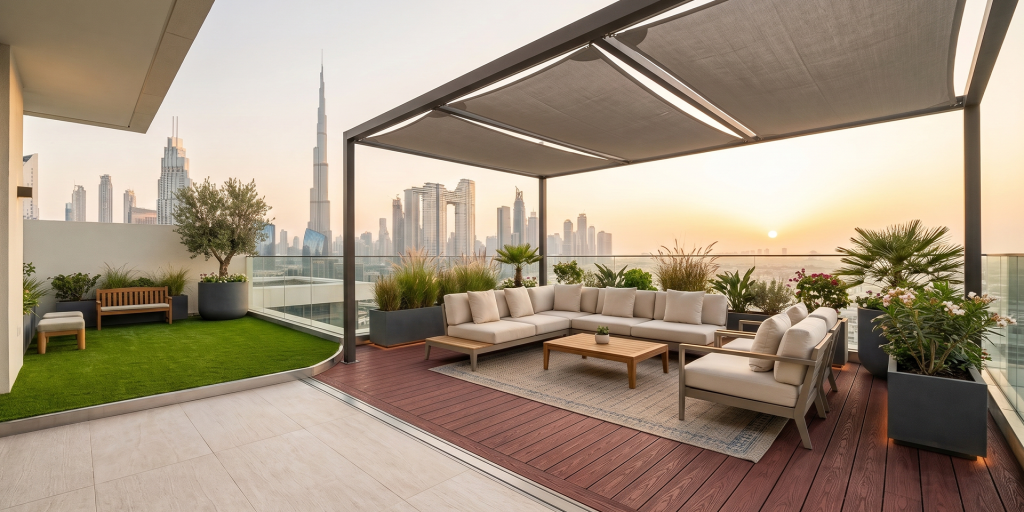
The right answer depends far more on the balcony than on the catalogue, so filter the balcony flooring ideas above by size first.
Small Balcony Flooring Ideas
On a compact apartment balcony, the priorities are visual continuity and reversibility. Run the boards or tiles in the direction of the longest wall to stretch the space, choose a light to mid tone so the area does not read as a dark box, and keep the pattern simple. The best small balcony flooring ideas use one material edge to edge, with the planting and furniture doing the decorating. Interlocking tiles win here because they need no tools and leave no trace.
Larger Terraces and Roof Spaces
With more area you can zone. Decking under the seating, a run of paving at the threshold, a strip of turf for children. Adding shade transforms usability more than any surface choice does, and a WPC pergola pairs cleanly with the same board finish underfoot. If you want the full technical picture on substructures and board grades, our guide to Outdoor Decking Dubai goes deeper than this overview can.
Waterproofing, Cost and What Actually Goes Wrong
Every balcony has a waterproof membrane between you and the apartment below, and no balcony flooring ideas are worth compromising it for. This is the argument for dry-laid systems and against anything screwed, drilled or glued down. When people ask for waterproof outdoor balcony flooring, what they usually need is a surface that lets water pass through and reach the drain, not one that seals it in.
On budget, expect the substructure and levelling to carry a meaningful share of the cost, not just the boards. Very cheap composite fades, cups and gets hot, and replacing it after two years costs more than specifying properly once. The failures we are called to fix are almost always the same three: blocked drainage, no expansion gap at the perimeter, and a board that was never UV rated for this region. Our breakdown of WPC Flooring Outdoor covers the specification detail that prevents all three.
The Short Answer
Of all the outdoor balcony flooring ideas available in this market, WPC in board or tile form is the one that consistently delivers: it looks like timber, it stays stable in the heat, it drains properly, it lifts out when the building needs access, and it does not demand annual sealing. Porcelain and stone earn their place on larger terraces with the budget to match, turf softens a hard corner, and a rug finishes the job. The material that fails is the one chosen on price alone. The best balcony flooring ideas start with your slab, your building rules and your sun exposure, then work towards the finish you want. Send us your balcony dimensions and a photo, request a free sample, and see how the board feels before you commit to it.